

 Marco Bezzecchi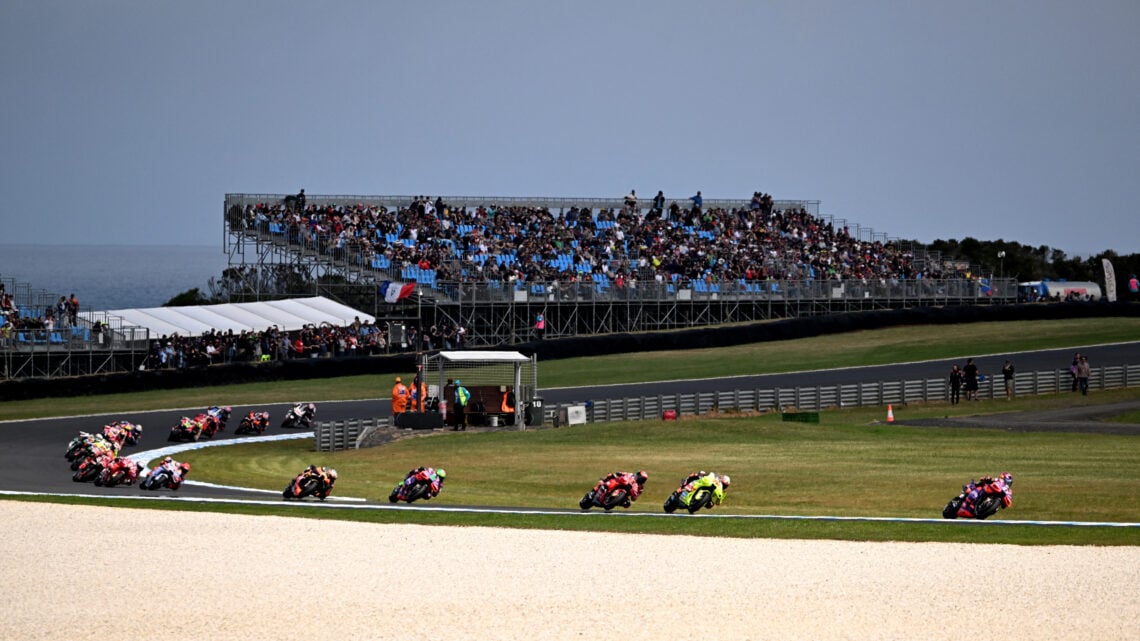


MotoGP’s decision to remove Phillip Island from the calendar next season sparked outrage amongst avid fans of the premier class. However, FIM President Jorge Viegas has asserted that it isn’t ‘goodbye forever’ for the iconic circuit.
After rumours of Phillip Island’s place on the MotoGP calendar being in jeopardy emerged during the latter stages of last year’s premier class campaign, every fan’s worst nightmare became real life last week.
After news broke that the grid wouldn’t be returning to the Victoria-based circuit in 2027, social media was rife with MotoGP fans sharing their fury over the ‘horrible decision’ to get rid of one of the most highly anticipated race weekends from the calendar.
The Australian Grand Prix is expected to be held in Adelaide instead, on a brand-new street circuit that the sport is hoping will appeal to a new audience and bring in more fans.
There has also been talk of the Grand Prix being given night race status, in a bid to suit European fans over the locals.
- READ MORE: Johann Zarco thinks Marc Marquez is the favourite to win Adelaide’s new MotoGP street race
Is MotoGP selling its soul by leaving Phillip Island?

FIM president Jorge Viegas hints at a potential return for Phillip Island to MotoGP in the future
During an interview with MCN Australia, the President of the International Motorcycling Federation, Jorge Viegas, discussed the reasons for Phillip Island’s departure from the MotoGP calendar and what may replace it.
The Portuguese executive addressed the fury of fans, while also noting how Phillip Island officials had ample time to address the issues that were raised at the Victoria-based circuit.
He said, “I mean, it’s obvious that this would happen one day or the other, when the discussion has to do with the promotion of the race and the conditions of Phillip Island.
“This was asked 10 years ago, that they should improve the facilities here, and every year they said, ‘Yeah, yeah, yeah, we will do it’. But it never happened, so now it’s gone.”
“Everybody loves this track. I love to come here, but if you want to invite people, if you want to make something different, there are no hotels, there’s nothing. It’s really difficult.
“So I think this is, let’s say, commercial based decision, but we can understand it. Everybody is sorry to lose Phillip Island in the calendar, obviously, but the last talk between [Carmelo] Ezpeleta and Mr Fox, it was that you do the facilities, and then we’ll talk about coming back. It’s not a goodbye forever.”
Ezpeleta previously shared his desire to introduce street circuits to MotoGP during an interview at a Formula 1 Grand Prix last year.
While the immediate desire was to introduce one of the current temporary city tracks on the F1 calendar, the Spaniard has seemingly got his wish with the proposal of the Australian GP taking place on the streets of Adelaide.
- READ MORE: Jeremy McWilliams believes the loss of Phillip Island for Adelaide was a ‘dark day for MotoGP’
Do you agree with Jack Miller’s comments on the Adelaide street circuit? 🤔

MotoGP riders are split over the move from a traditional race track to a street circuit
With fans making their stance clear on Phillip Island’s snub, past and present MotoGP riders have been more split in their opinions on the decision.
Jack Miller thinks the proposed move to Adelaide is ‘amazing news’ for the sport, despite his MotoGP legacy being intertwined with Phillip Island as the recipient of a corner named after him.
Joining him in the defence of Adelaide is Aleix Espargaro. The Spaniard believes the Victoria-based circuit is simply too ‘dangerous’ for the speeds that premier class prototypes travel at today, and welcomes the move to a new state-of-the-art track.
On the other hand, Miguel Oliveira has highlighted the ‘crazy’ risks of MotoGP turning to street tracks to increase the popularity of the sport.
Of course, without the ability to use as much space as they can, certain safety issues, like sufficient run-off areas, may crop up.
Receive racing news and updates twice a week to your mailbox


