

 Marco Bezzecchi
| First held: | 1987 |
| Times held: | 36 |
| Circuit: | Mobility Resort Motegi |
| Circuit length: | 4.8km (2.9m) |
| Laps: | 24 |
| Most wins: | 4x Kevin Schwantz (1988, 1989, 1991, 1994) |
| 4x Valentino Rossi (2001, 2002, 2003, 2008) |
The Grand Prix of Japan (also known as the Japanese GP) is a premier MotoGP round, which served as the 500cc world championship’s first race in Asia in the 1987 season.
Premier class motorcycle racing was largely a European and Americas affair during the early years of the 500cc world championship. Even the 50cc, 125cc, 250cc and 350cc series hit Asian soil before the 500cc class with the 1963 Japanese Grand Prix a breakthrough edition.
No world championship rounds at any level were held in Japan from 1968 to 1986, however. Yet upon the 500cc class finally staging a Japanese GP in 1987, the race stayed a constant piece of the calendar until MotoGP skipped it in 2020 and 2021 due to Covid-19 restrictions.
History of the MotoGP Grand Prix of Japan
The Grand Prix of Japan is a huge part of 500cc/MotoGP history, having marked not only the premier class’ breakthrough in Asia but the world championship’s. While the 500cc class did not run a Japanese GP until 1987, Suzuka first hosted 50cc, 125cc and 250cc races in 1963.
Suzuka also held the first 350cc Japanese Grand Prix in 1964 with all four lower classes then coming together in Japan for the first time in 1965. Yet after only three runnings with all four lower classes, the race disappeared until 1987 as the 250cc and 500cc classes competed.
The Fuji Speedway also briefly took up hosting the Grand Prix of Japan for the 50cc, 125cc, 250cc and 350cc classes in 1966 and 1967. But Suzuka would resume hosting as the 250cc and 500cc classes revived the Japanese GP in 1987, and continued to get the race to 1998.
Fuji is still yet to welcome any world championship class back to the footsteps of Mount Fuji since 1967. Instead, Motegi held its first Japanese Grand Prix in 1999 and took over hosting duties exclusively since 2004, following a return to Suzuka over the 2000 to 2003 seasons.
Why did MotoGP stop hosting the Japanese Grand Prix at Suzuka?
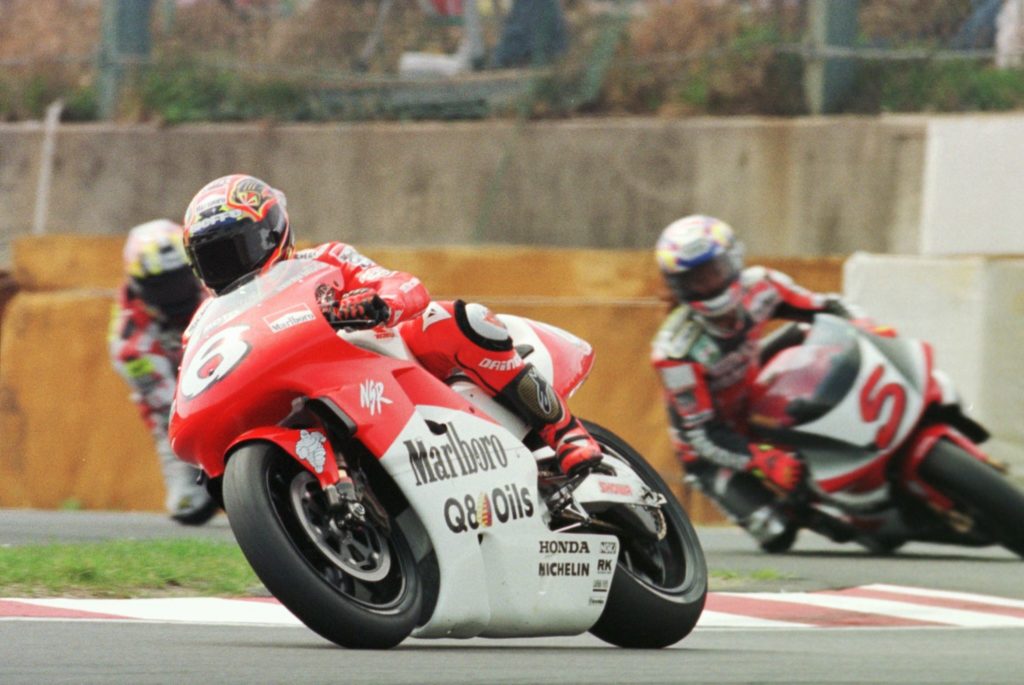
MotoGP permanently moved the Japanese Grand Prix from Suzuka to Motegi in 2004 as the circuit Honda owns was deemed too dangerous to stage world championship rounds. Many riders felt MotoGP outgrew Suzuka and threatened a strike due to the limited run-off areas.
Suzuka would have required substantial alterations to remain on the MotoGP calendar as it was initially planned to for 2004 following Daijiro Kato’s fatal crash in the 2003 Japanese GP. Marco Melandri and Alex Barros had also hit the trackside barriers after crashing in practice.
As the alterations could not be completed in time for Suzuka to still host the season-opening 2004 Japanese GP, MotoGP elected to change the name of the 2004 Pacific Grand Prix at Motegi. Discussions continued for MotoGP to return to Suzuka in 2005 but did not work out.
With Motegi – another circuit Honda owns – taking over the Grand Prix of Japan, the Pacific Grand Prix did not return to the MotoGP calendar after four editions. After staging the 1999 Japanese GP, Motegi held the Pacific GP in 2000-2003 as an additional round in the country.
American riders and Japanese bikes dominated the early runnings of the Grand Prix of Japan
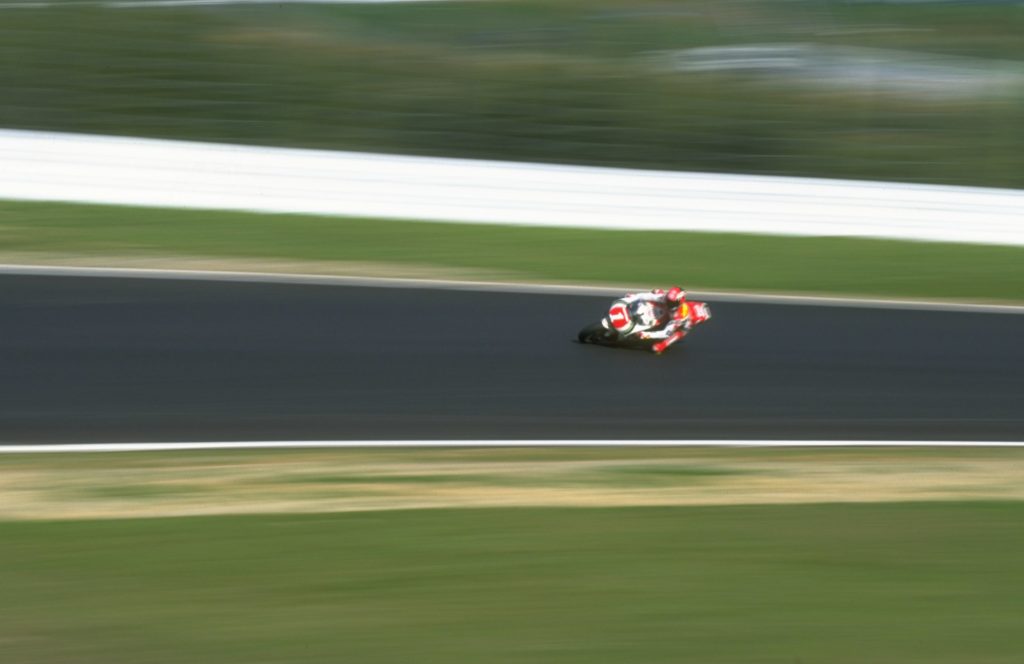
The Grand Prix of Japan at Suzuka was the traditional first race of a 500cc/MotoGP season from the circuit’s premier class debut in 1987 to its last race in 2003. But after MotoGP took the Japanese GP to Motegi in 2004, it has seldom held it outside of September and October.
Randy Mamola secured the honour of winning the inaugural 500cc Grand Prix of Japan on a Japanese bike in 1987, too. The Team Roberts rider took his Yamaha YZR500 to the top step of the podium at Suzuka in round one that year, to start his ultimately unsuccessful title bid.
American riders loved their trips to Suzuka over the early editions of the 500cc Japanese GP, whilst even delivering Japanese brands further success at home. Yamaha, Suzuki and Honda bikes won all of the first 18 runnings before Ducati won a Japanese GP in the 2005 season.
Seven of the first eight editions of the 500cc Grand Prix of Japan also saw an American rider stand triumphant at Suzuka. Kevin Schwantz and Wayne Rainey mopped up after Mamola’s moment at the maiden running, with Australia’s Mick Doohan interrupting their run in 1992.
Suzuki even saw Schwantz score the first win of the season in 1988 and 1989 to become the first repeat winner of the Grand Prix of Japan. Suzuka had to wait until 2001, 2002 and 2003 to witness another repeat Japanese GP winner, as Valentino Rossi secured Honda the treble.
But after winning at Suzuka with Nastro Azzurro in 2001 and with the factory Honda crew in 2002 and 2003, the Japanese Grand Prix switching to Motegi marked the end of the Italian’s streak. Rossi would not achieve his first Japanese GP win at Motegi until 2008 with Yamaha.
Honda bikes initially remained the ones to beat in Japan as Makoto Tamada won the 2004 Japanese GP at Motegi for Honda Pons on an RC211V. Yet Ducati found the key in 2005 and saw Loris Capirossi record three successive wins at Motegi with the Borgo Panigale squad.
Suzuka was Kevin Schwantz’s playground but wildcard Norifumi Abe stunned the 1994 Japanese Grand Prix

Suzuka was firmly one of Schwantz’s strongest tracks on the calendar with wins at the Grand Prix of Japan in the 1988, 1989, 1991 and 1994 seasons. Yet even the Texan as the reigning 1993 500cc champion struggled to stop Norifumi Abe from taking the win on debut in 1994.
Home rider Abe earned a surprise wildcard entry for the 1994 Japanese GP riding for the Mr Donut Blue Fox Honda squad at 18 years old. Yet the Setagaya, Tokyo native was instantly at ease racing the top names on the 500cc grid with Schwantz and factory Honda star Doohan.
Abe immediately shot from anonymity into the spotlight at the newly-resurfaced Suzuka. He took advantage of the teenager’s home knowledge as rival riders guessed with their set-ups after rain washed out qualifying, while Schwantz’s poor start left him down in seventh place.
Luca Cadalora bolted clear in the lead after taking the soft option front Dunlop tyre, and he soon built a strong lead whilst Doohan and Abe moved passed Alex Criville for P2 and P3. It would take Schwantz until the end of just Lap 6 with lap-record pace to get second, though.
Cadalora’s decision to demand a soft front tyre also started to backfire as the Team Roberts rider’s grip levels quickly fell away. But very much to the surprise of Doohan and Schwantz, Abe started to emerge as a threat with quickfire passes at the chicane and then first corner.
Schwantz could do nothing to react as Abe flew into the first bend and out-braked the 1993 champion down his inside from nowhere. The wildcard took risk after risk and only just kept going at times, but it paid off as Abe passed Cadalora for the lead on L9 at the Spoon Curve.
It was then a three-way fight between Abe, Schwantz and Doohan with the lead repeatedly changing hands. Even when Schwantz eventually started to create a lead on L16, Abe’s late braking kept thwarting Doohan. Yet pushing the limits, ultimately, bit for Abe on L18 of 21.
With Schwantz starting to romp to glory again at the Grand Prix of Japan, Abe’s desire to win at home on his 500cc debut ended in the gravel. “I was sure I could have come second, but I wanted to win,” Abe later said after seeing Schwantz beat Doohan by 3.474 seconds to win.
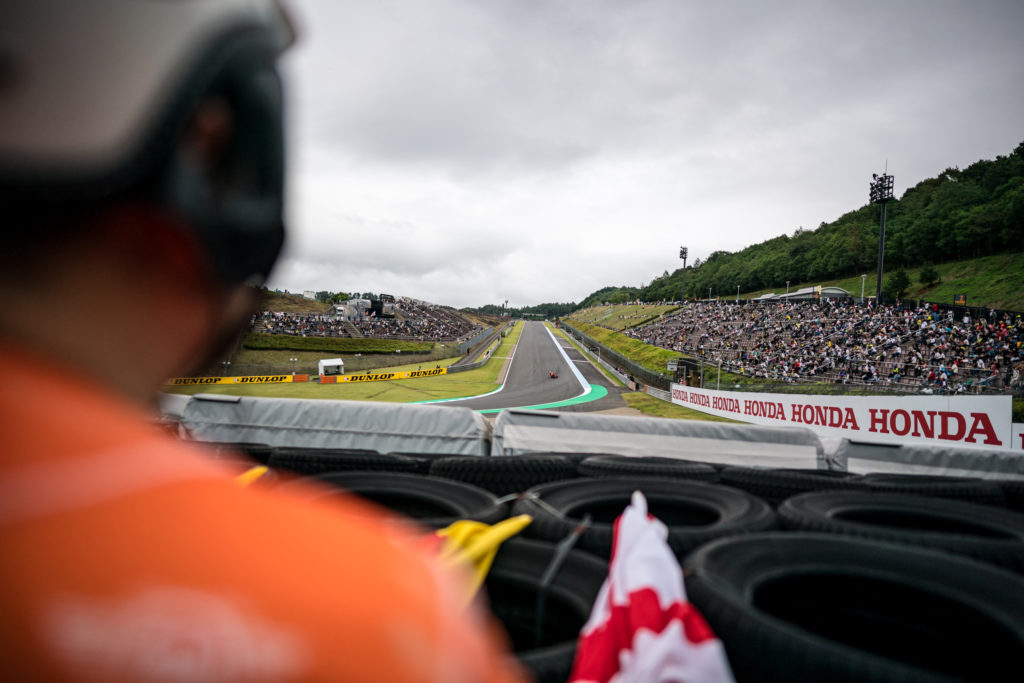
What is the Mobility Resort Motegi circuit like?

Suzuka was loved by many premier class riders over the circuit’s time hosting the Grand Prix of Japan. It had an ideal mix of sweeping corners taken at various speeds, elevation changes and a final chicane which often yielded a last-lap duel to get on the top step of the rostrum.
In contrast, Motegi has not always been a riders’ or a fans’ favourite circuit since taking over hosting the Japanese Grand Prix in 2004. Yet the circuit does offer a wide mix of corners and straights, which can deliver exciting races when MotoGP visits the track Honda built in 1997.
Overtakes are possible throughout any lap of the Mobility Resort Motegi circuit – which was originally called Twin Ring Motegi owing to it also having an oval track that was last raced on in 2010. Turns 1, 3, 5, 7, 9, 10 and 11 are the major overtaking points during a lap at Motegi.
Riders need a strong run through Turns 5 and 6 to set up a move under braking for T7, while attempting a move into T9 can jeopardise a pilot’s run to T10. It can also be a risk to attempt a move at T10 due to the 762-metre-long straight, the longest at the track, down to Turn 11.
With the 762-metre straight also running downhill, it is easy to go deep on the brakes when attempting a pass or simply trying to take Turn 11. Riders will often run side-by-side exiting T11 to claim the inside for Turn 12, which is crucial to lead into the chicane to close the lap.
Winners of the MotoGP Grand Prix of Japan
Below, MotoGP News has listed every premier class rider to win the Japanese Grand Prix…
| YEAR | RIDER | TEAM | CONSTRUCTOR |
| 1987 | Randy Mamola | Team Roberts | Yamaha |
| 1988 | Kevin Schwantz | Suzuki | Suzuki |
| 1989 | Kevin Schwantz | Suzuki | Suzuki |
| 1990 | Wayne Rainey | Team Roberts | Yamaha |
| 1991 | Kevin Schwantz | Suzuki | Suzuki |
| 1992 | Mick Doohan | Honda | Honda |
| 1993 | Wayne Rainey | Team Roberts | Yamaha |
| 1994 | Kevin Schwantz | Suzuki | Suzuki |
| 1995 | Daryl Beattie | Suzuki | Suzuki |
| 1996 | Norifumi Abe | Team Roberts | Yamaha |
| 1997 | Mick Doohan | Honda | Honda |
| 1998 | Max Biaggi | Team Kanemoto | Honda |
| 1999 | Kenny Roberts Jr | Suzuki | Suzuki |
| 2000 | Norifumi Abe | d’Antin Antena 3 | Yamaha |
| 2001 | Valentino Rossi | Nastro Azzurro | Honda |
| 2002 | Valentino Rossi | Honda | Honda |
| 2003 | Valentino Rossi | Honda | Honda |
| 2004 | Makoto Tamada | Honda Pons | Honda |
| 2005 | Loris Capirossi | Ducati | Ducati |
| 2006 | Loris Capirossi | Ducati | Ducati |
| 2007 | Loris Capirossi | Ducati | Ducati |
| 2008 | Valentino Rossi | Yamaha | Yamaha |
| 2009 | Jorge Lorenzo | Yamaha | Yamaha |
| 2010 | Casey Stoner | Ducati | Ducati |
| 2011 | Dani Pedrosa | Honda | Honda |
| 2012 | Dani Pedrosa | Honda | Honda |
| 2013 | Jorge Lorenzo | Yamaha | Yamaha |
| 2014 | Jorge Lorenzo | Yamaha | Yamaha |
| 2015 | Dani Pedrosa | Honda | Honda |
| 2016 | Marc Marquez | Honda | Honda |
| 2017 | Andrea Dovizioso | Ducati | Ducati |
| 2018 | Marc Marquez | Honda | Honda |
| 2019 | Marc Marquez | Honda | Honda |
| 2022 | Jack Miller | Ducati | Ducati |
| 2023 | Jorge Marin | Pramac | Ducati |
| 2024 | Francesco Bagnaia | Ducati | Ducati |


