

 Marco Bezzecchi
| First held: | 1971 |
| Times held: | 34 |
| Circuit: | Red Bull Ring |
| Circuit length: | 4.3km (2.7m) |
| Laps: | 28 |
| Most wins: | 3x Giacomo Agostini, Kenny Roberts, Eddie Lawson, Kevin Schwantz, Mick Doohan, Andrea Dovizioso, Francesco Bagnaia |
The Grand Prix of Austria (also known as the Austrian GP) is a fan-favourite MotoGP race, with roots going back to its inaugural running in the 1971 500cc championship.
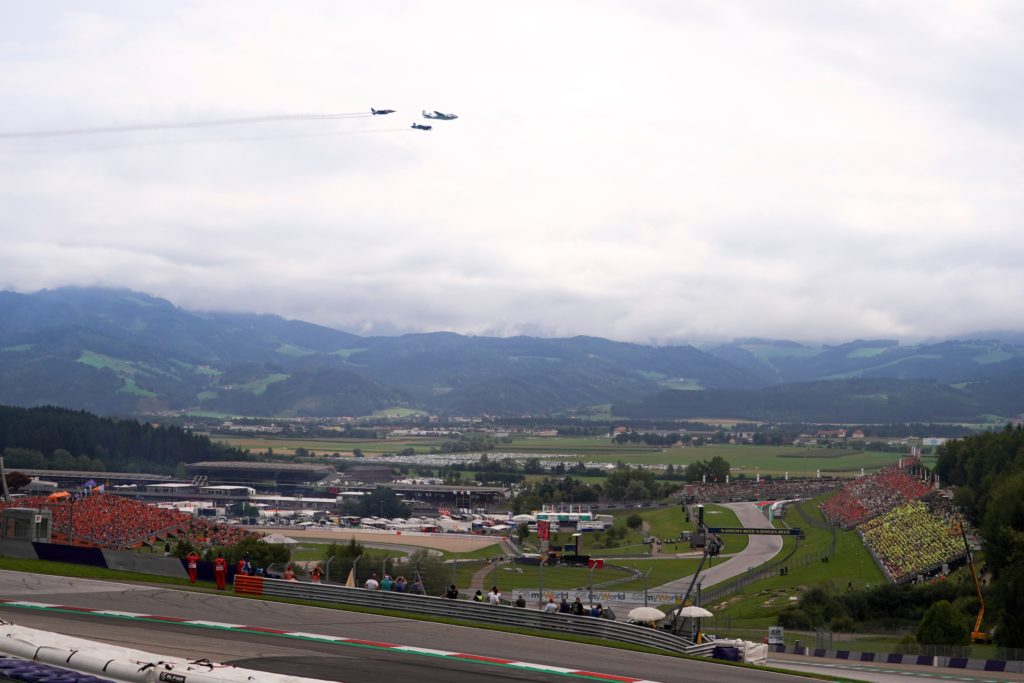
Riders have regularly praised the Austrian GP for the ‘insane’ atmosphere fans offer the race held at the Red Bull Ring in Spielberg, Styria. The premier class has visited the track formerly known as the A1-Ring since 1996 after the 500cc class left the Salzburgring after 22 visits.
The Salzburgring had offered the 500cc world championship a home in Austria for every visit from the maiden 1971 running to the 1995 season. But it lost the race to the A1-Ring, which was also the circuit where MotoGP revived the Austrian GP in 2016 after an 18-year hiatus.
History of the MotoGP Grand Prix of Austria
The Austrian Grand Prix at the Red Bull Ring has been one of the most-loved rounds for fans and also riders since its return to the MotoGP calendar in 2016. MotoGP recognised the love the paddock soon had for the Red Bull Ring with its Best Grand Prix award in 2016 and 2019.
MotoGP fans have also witnessed some incredible races at the Austrian Grand Prix since the Red Bull Ring returned to the premier class’ schedule. Marc Marquez with Honda and Ducati pilot Andrea Dovizioso especially produced some incredible battles for Austrian GP victories.
Partly down to its absence from the schedule from 1998 to 2015, the Austrian GP is also one of the very few MotoGP races that Valentino Rossi never won during the Italian’s seven-time premier class title-winning career. Rossi even never won in Austria racing in the 125cc class.
Numerous riders have achieved success in Austria since the 500cc world championship first paid a visit to the Salzburgring in 1971 and after the Grand Prix moved to Spielberg in 1996. Italian icon Giacomo Agostini even dominated the early runnings of the Austrian Grand Prix.
Ducati have dominated the Red Bull Ring since MotoGP revived the Austrian GP in 2016
While riding for MV Agusta, Agostini won the first two editions of the Austrian Grand Prix as part of the 500cc world championship in 1971 and 1972. He also returned to the top step of the podium in 1974 after defecting to rivals Yamaha, for whom Jarno Saarinen won in 1973.
Yamaha machinery were often the bikes to beat at the Austrian GP from 1973 to 1983, with the Japanese brand seeing their chassis claim six wins from 10 runnings. Barry Sheene, Jack Findlay, Randy Mamola and Franco Uncini broke up Yamaha’s dominance racing on Suzukis.
Honda also enjoyed a period of dominance at the Salzburgring once Yamaha’s reign over the Austrian GP finished. Freddie Spencer, Eddie Lawson and Wayne Gardner took control of the race in the 1980s before Kevin Schwantz and Mick Doohan led the new Suzuki vs Honda era.
MotoGP reviving the Austrian GP in 2016 did not also return further dominance for Yamaha, Suzuki or Honda, though. Instead, Ducati made the Red Bull Ring the Borgo Panigale crew’s playground with five consecutive Austrian Grand Prix wins – with Dovizioso delivering three.
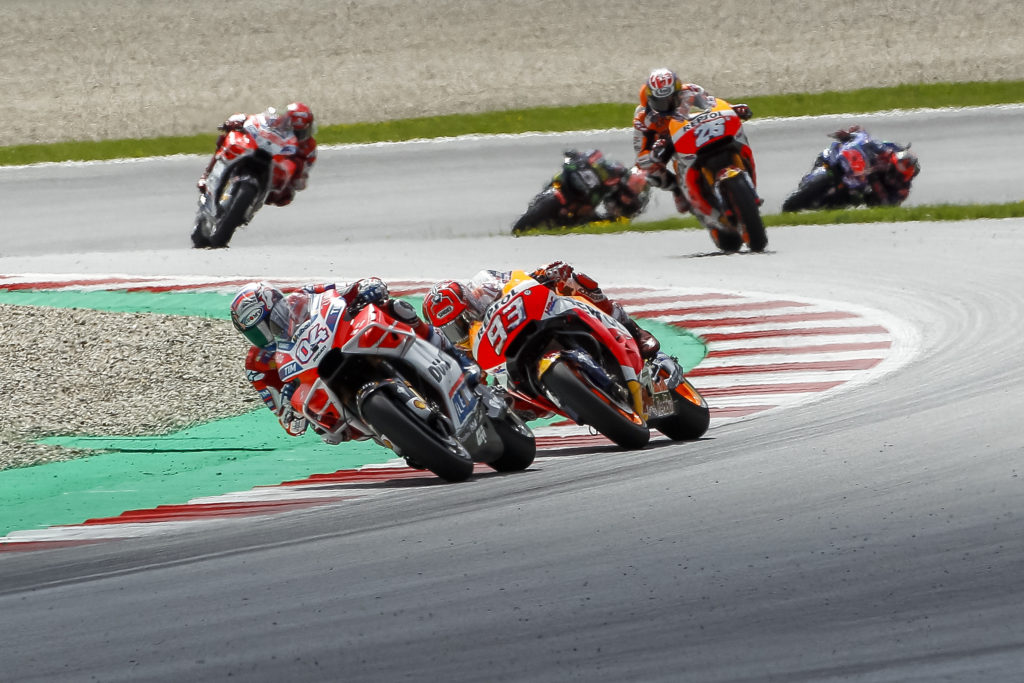
Dovizioso even led home one of the closest finishes in MotoGP history at the 2017 Austrian Grand Prix, with the top 15 riders separated by just 28.096 seconds. He also took the win by 0.176 seconds to Marquez after a fierce fight with the Ducati rider’s Honda rival to the flag.
Andrea Dovizioso and Marc Marquez produced all-time MotoGP classics at the 2017 and 2019 Austrian Grands Prix

Marquez and Dovizioso did battle throughout the 2017 Austrian GP and their fight went the distance. A repeat was even on the cards in 2019 when Dovizioso beat Marquez to another Austrian GP win by a margin of only 0.213s after pulling a daring dive into the final corner.
Dovizioso blocked Marquez into the downhill Turn 9 in 2017 to try and seal the win, only for the Spaniard to dive back at the Italian into T10 with a desperate last throw of the dice. The move was not on, however, so Marquez had to slam on the brakes and Dovizioso cut back.
Roles were then reversed in 2019 as Marquez tried to hang on to what would have been the Spaniard’s first Austrian Grand Prix victory with Dovizioso hot on the Honda star’s tail. Yet by not looking to pull a move at T9, Dovizioso got the run for T10 and braked at the ideal point.
It was not until the 2021 Austrian Grand Prix that a rival manufacturer disrupted Ducati’s run of wins following MotoGP’s return to the Red Bull Ring. It also took Brad Binder braving it on slicks in the rain while rivals stormed with wet tyres to see KTM win the Austrian GP in 2021.
Valentino Rossi had a lucky escape after Franco Morbidelli and Johann Zarco’s 2020 Austrian Grand Prix crash
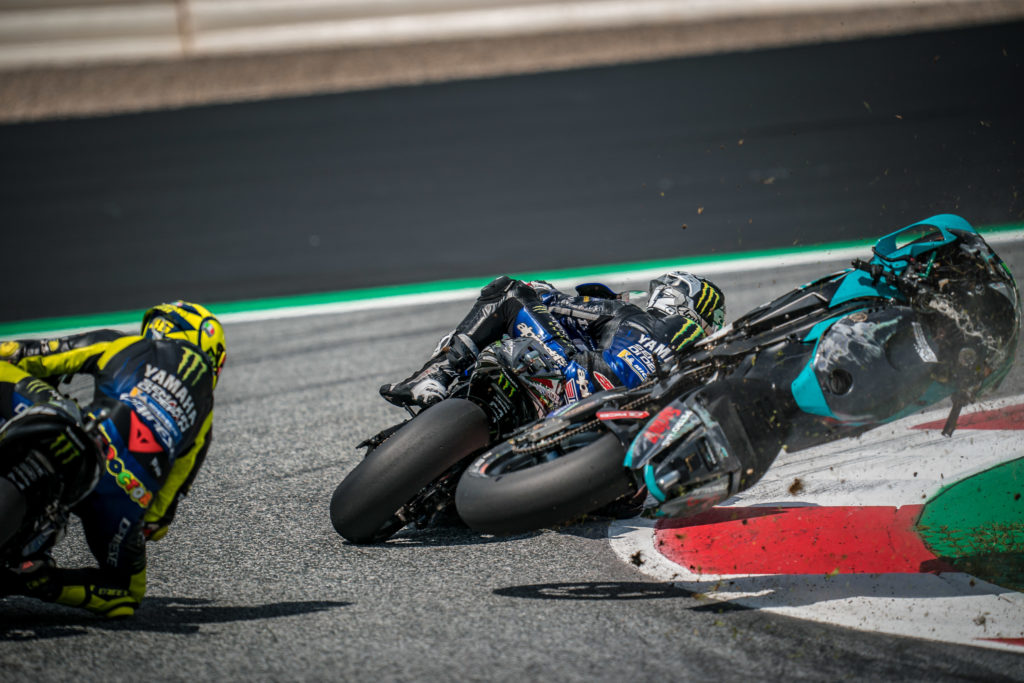
The 2020 Austrian Grand Prix yielded yet another Ducati win as Dovizioso edged Suzuki star Joan Mir to the flag by 1.377s. But the premier class’ trip to the Red Bull Ring that term will forever be remembered for the horrific crash between Franco Morbidelli and Johann Zarco.
Maverick Vinales and Rossi were extremely fortunate as the Yamaha teammates had a very lucky escape after Morbidelli and Zarco collided on the uphill run for T3. Rossi expedited his decision to retire from MotoGP due to Morbidelli and Zarco’s crash in the 2020 Austrian GP.
The incident started when Petronas SRT ace Morbidelli clipped the rear of Zarco’s bike after the Esponsorama Racing ace drifted over his nose, knocking both riders off their machines. But as they tumbled through the gravel at high speed, their bikes continued towards Turn 3.
Morbidelli’s satellite Yamaha bike scrubbed the grass as it skidded directly towards the apex of Turn 3, before flipping upon digging in and miraculously flying between Vinales and Rossi as they took the corner. Rossi came face-to-face with Morbidelli’s bike as it flew by in a flash.
Within another flash, Zarco’s bike also flew over Vinales’ head and narrowly evaded Rossi as the Frenchman’s satellite Ducati disintegrated following its impact with the trackside barrier. The Red Bull Ring extended the barrier to the inside of T3 in 2021 to avoid a repeat incident.
What is the Red Bull Ring like?

The Red Bull Ring has been a mainstay of the MotoGP calendar since the premier class went back to the track in 2016 to revive the Austrian Grand Prix after nearly two decades. It is one of the best-attended rounds on the schedule, as well, with fans flocking into the Styrian hills.
Race promoters make the event around the Austrian GP into a festival – even if the layout of the Red Bull Ring might not always naturally produce exciting racing with MotoGP becoming increasingly aero-heavy, which was not helped by the addition of the Turn 2 chicane in 2022.
It is also all too easy especially at the start of a race for riders to run wide exiting Turn 1 due to the tight nature of the uphill, right-hand turn. The T2 chicane is also a tricky challenge to master with riders requiring a wide entry for the first part, but risk running wide on the exit.
If a rider can stay close to their rival in front through the first two sectors, the third zone can provide a chance for a brave overtaking move. Yet a poor exit out of Turn 7 or cutting T8 can leave a rider exposed for the heavy braking point into the difficult, downhill T9 right-hander.
Turns 9 and 10 present some of the biggest challenges during a lap of the Red Bull Ring with the last two turns at the home of the Austrian Grand Prix very easy to run wide out of. Track limits at T9 in particular is a huge issue but a good run can allow for a late overtake into T10.
Fuel consumption and tyre wear can also be a key point of focus during the Austrian Grand Prix, with the Red Bull Ring also one of the toughest tracks on the calendar for braking. The stop-start nature of the track delivers heavy braking points at Turns 1, 2, 3, 4, 6, 7, 9 and 10.
Winners of the MotoGP Grand Prix of Austria
Below, MotoGP News has listed every premier class rider to win the Austrian Grand Prix…
| YEAR | RIDER | TEAM | CONSTRUCTOR |
| 1971 | Giacomo Agostini | MV Agusta | MV Agusta |
| 1972 | Giacomo Agostini | MV Agusta | MV Agusta |
| 1973 | Jarno Saarinen | Yamaha | Yamaha |
| 1974 | Giacomo Agostini | Yamaha | Yamaha |
| 1975 | Hideo Kanaya | Yamaha | Yamaha |
| 1976 | Barry Sheene | Suzuki | Suzuki |
| 1977 | Jack Findlay | Hermetite Racing International | Suzuki |
| 1978 | Kenny Roberts | Yamaha USA | Yamaha |
| 1979 | Kenny Roberts | Yamaha USA | Yamaha |
| 1981 | Randy Mamola | Heron Suzuki | Suzuki |
| 1982 | Franco Uncini | Gallina Suzuki | Suzuki |
| 1983 | Kenny Roberts | Yamaha | Yamaha |
| 1984 | Eddie Lawson | Team Agostini | Yamaha |
| 1985 | Freddie Spencer | Honda | Honda |
| 1986 | Eddie Lawson | Team Agostini | Yamaha |
| 1987 | Wayne Gardner | Honda | Honda |
| 1988 | Eddie Lawson | Team Agostini | Yamaha |
| 1989 | Kevin Schwantz | Suzuki | Suzuki |
| 1990 | Kevin Schwantz | Suzuki | Suzuki |
| 1991 | Mick Doohan | Honda | Honda |
| 1993 | Kevin Schwantz | Suzuki | Suzuki |
| 1994 | Mick Doohan | Honda | Honda |
| 1996 | Alex Criville | Honda | Honda |
| 1997 | Mick Doohan | Honda | Honda |
| 2016 | Andrea Iannone | Ducati | Ducati |
| 2017 | Andrea Dovizioso | Ducati | Ducati |
| 2018 | Jorge Lorenzo | Ducati | Ducati |
| 2019 | Andrea Dovizioso | Ducati | Ducati |
| 2020 | Andrea Dovizioso | Ducati | Ducati |
| 2021 | Brad Binder | KTM | KTM |
| 2022 | Francesco Bagnaia | Ducati | Ducati |
| 2023 | Francesco Bagnaia | Ducati | Ducati |
| 2024 | Francesco Bagnaia | Ducati | Ducati |
| 2025 | Marc Marquez | Ducati | Ducati |


