

 Marco Bezzecchi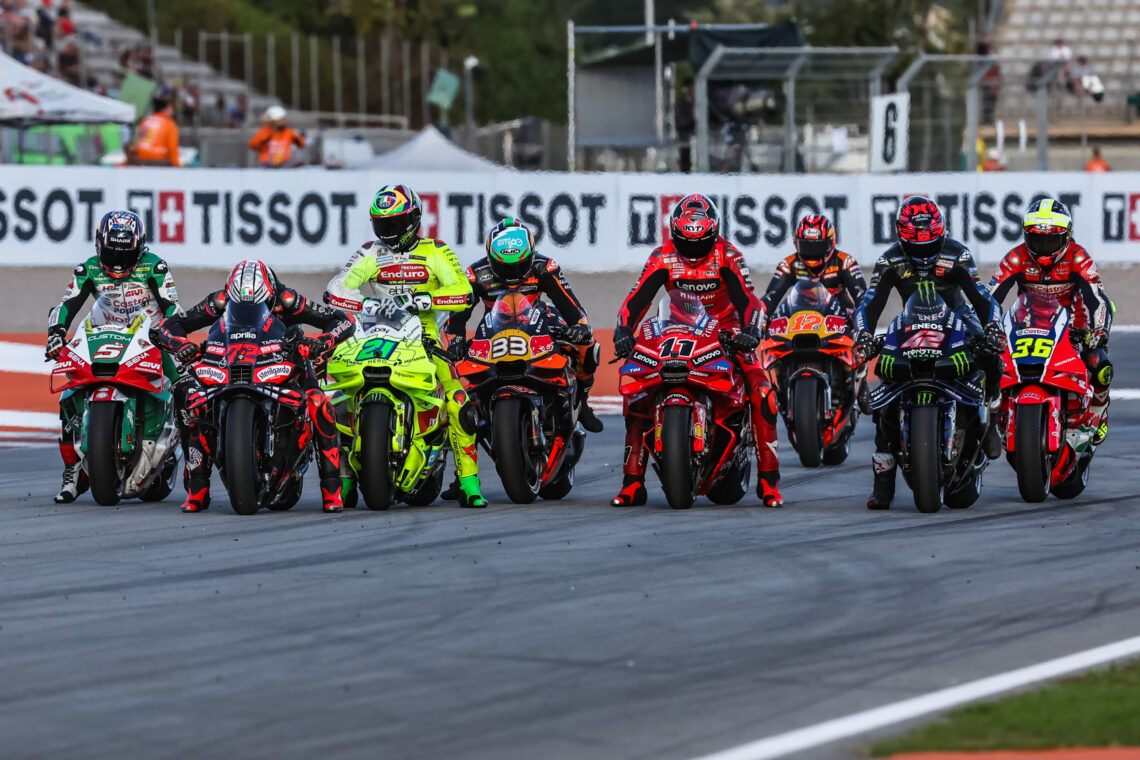


Liberty Media completed its takeover of Dorna Sports in July 2025, and many MotoGP fans are now wondering about how F1’s owners may transform the two-wheel series.
The American corporation purchased 84% of the shares in Dorna, the exclusive commercial rights holders of the MotoGP world championship, for €4.3bn (£3.7bn). Dorna CEO Carmelo Ezpeleta and its COO Enrique Aldama retained the remaining stake in the Spanish company.
Liberty seized its chance to couple owning F1 with MotoGP, as it sees huge scope for growth in the two-wheel series. It will particularly look to enhance the championship’s appeal in the North American market, in which F1 has considerably tapped into in its Drive to Survive era.
The prospect of Liberty utilising some of its F1 know-how in MotoGP also remains on the cards, beyond Ezpeleta opening the door for MotoGP to race on F1 street circuits. With that in mind, MotoGP News has taken a look at some of the F1 rules that Liberty must introduce.

Liberty Media must ban traction control in MotoGP to give riders a bigger challenge
Liberty can already market MotoGP as a championship in which riders push themselves past limits that mere mortals would not even dream about pushing. But Liberty can also increase the challenge riders face by banning traction control and other electronic aids from MotoGP.
READ MORE: The perfect MotoGP calendar after Carmelo Ezpeleta teased F1 street tracks
What would you change on our dream 2027 grid?

F1 has sporadically allowed traction control throughout its history since 1950, but it banned the driver aid most recently in 2008, and the four-wheel championship has not looked back. F1 drivers must control all wheel spin and the racing product is better as a result of the ban.
MotoGP actually went the other way during the 2025 season, as it introduced a new form of stability control at the Austrian Grand Prix. The new system was aimed at limiting the engine torque when a bike slides, but it also drew criticism from some of MotoGP’s leading figures.
Ducati rider Marc Marquez declared during the pre-event Thursday press conference at the Red Bull Ring in August: “For me, it’s clear. The more things you introduce on the bike, in this case electronics, the less difference the rider can make.
“You can be [pushing] against the control and the bike is doing everything. So, as a rider, I don’t like it. [Regardless of whether it is for] safety or not.”
KTM rider Pedro Acosta also stated in Austria: “Every time we are introducing [electronic aids], I think we have to go the other way around.
“Try to remove it, like we see in the new regulations for 2027, [when] we start to take out the [ride height] device and all these things. I think we have to start to think about taking out these aids that we have on the bike.”
Marquez would be one rider who would likely benefit if MotoGP was to ban traction control, which other two-wheel series such as the British Superbike championship already adopts. BSB bans traction control to level the playing field and to make races more exciting for fans.
Casey Stoner is in awe of how Marquez can ride ahead of MotoGP’s traction control with his natural feel for the throttle. The Australian believes the Spaniard, who dominated MotoGP in 2025 with 11 Grand Prix and 14 Sprint wins, is the only rider who does not rely on the TC.
MotoGP should use different sessions to set the grid for the Sprint Race and Grand Prix
Another way that Liberty can use F1 to improve MotoGP is by having two different sessions set the grid for the Sprint Race and the Grand Prix each week. F1 uses a separate qualifying session to set the grid for both of its two race types, while MotoGP currently only uses one.
What MotoGP rule would you like to see Liberty Media change?

MotoGP would not necessarily have to change its race weekend format to match F1’s, which sees drivers contest Sprint Qualifying on a Friday and the Sprint Race on a Saturday followed by its Grand Prix qualifying session. F1 only has six Sprints per year, rather than at each race.
MotoGP already uses its second practice session on the Friday of a race weekend as a pre-qualifying session to determine which riders advance straight into Q2 and which riders have to go through Q1. So, the Friday practice session could be used as a qualifying session, too.
The lap times that riders register during the Friday pre-qualifying practice session could still determine who heads into Q2, but they can also be used to set the grid for the Sprint. That way, MotoGP can increase the variability between the Sprint and the Grand Prix each week.
MotoGP should reduce the number of riders who can score points in each Grand Prix
F1 last modified its Grand Prix scoring system in 2010, seven years before Liberty bought the series. Formula 1 moved from only having the top eight finishers score points (10-8-6-5-4-3-2-1) to the top 10 finishers register points (25-18-15-12-10-8-6-4-2-1) for the first time.
READ MORE: The five Moto2 riders who MotoGP fans should be watching in 2026
The only change that Liberty has tried to make with F1’s scoring system was the failed move to give a point to the driver inside the top 10 who set the fastest lap between the 2019 and 2024 seasons. F1 teams often rigged the system by pitting for new tyres if they had a space.
While Liberty should not consider trying the fastest lap point idea in MotoGP, it should look at reducing the number of riders who score points from 15 down to 10. Riders will often try to hang around near the rear of the field even if they have crashed to sneak into the points.
The average number of riders to finish a Grand Prix through the 2025 MotoGP season was also 17.1, just over the 15 who can score a point every race. Also, only 10 riders finished in Germany, 14 finished in Indonesia and 16 finished in the Netherlands, Hungary and Misano.
MotoGP should copy F1 and ban the sharing of data across teams
One of the biggest differences between MotoGP and Formula 1 is that the former allows for satellite teams who run customer or factory-specification bikes, whereas the latter does not allow customer cars. F1 also bans the transfer of any technical data across different teams.
Which F1 street track should MotoGP stage a race at? Let us know why in the comments!
F1 is firmly opposed to the prospect of seeing outfits have an A-Team and a B-Team, despite Red Bull GmbH owning two outfits with Red Bull Racing and Racing Bulls. MotoGP, however, welcomes the transfer of data and ideas between a factory team and their satellite outfit(s).
Ducati work closely with their satellite squads in VR46 and Gresini, Aprilia work closely with Trackhouse Racing and Honda have LCR in their fold. Tech3 and Pramac are even essentially secondary factory teams for KTM, who run Tech3 in their colours, and Yamaha respectively.
But Liberty has to consider making MotoGP follow F1 by banning the transfer of data across teams. While it may risk the independent crews becoming slightly less competitive, it would also make the factory squads less competitive as they would have less data for their set-ups.
Liberty should consider introducing an F1-style cost cap in MotoGP
One of the biggest ways that Liberty Media, F1 and governing body The FIA have helped the teams in the four-wheel championship to drastically improve their values in recent seasons was the introduction of a cost cap in 2021. Now, every F1 team is worth more than £1.1bn.
READ MORE: Everything to know about Tech3 owner Guenther Steiner, including F1 history
Forbes cites Haas as the least valuable of the 10 F1 teams in 2025 at $1.5bn (£1.1bn), while Ferrari ($6.5bn/£4.8bn), Mercedes ($6bn, £4.4bn) and McLaren ($4.4bn, £3.3bn) are the three most valuable teams. Toto Wolff also recently sold a 5% stake in Mercedes for £230m.
In comparison, F1 cult hero Guenther Steiner led a consortium in buying Tech3 from Herve Poncharal for just under €20m (£17.5m) in September. Other F1 figures are also looking at buying MotoGP teams, knowing the potential that Liberty has to increase their valuations.
Liberty introducing an F1-style cost cap in MotoGP could be one of the ways that it looks to improve team valuations. It could also help the smaller teams to improve their budgets and entice more sponsors by being able to celebrate a more competitive product in the future.
Receive racing news and updates twice a week to your mailbox


