

 Marco Bezzecchi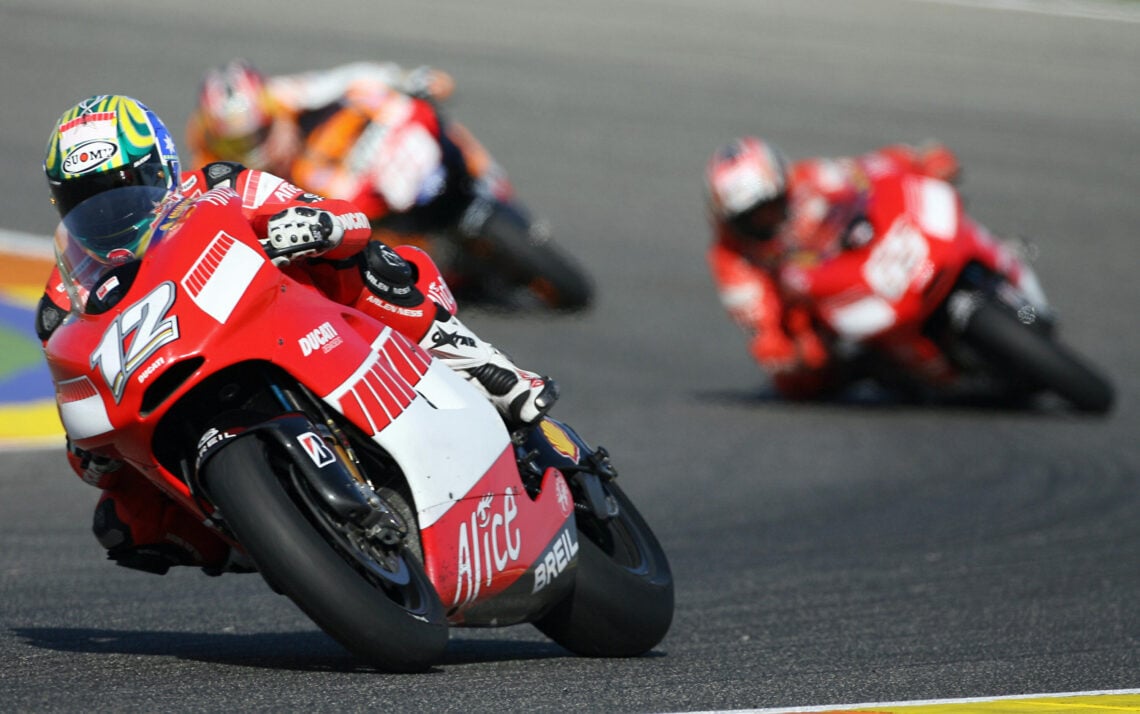


MotoGP teams often utilise wildcard riders to test updates or a completely new bike for their full-time pilots, but some stars have shone when only offered a rare chance.
The concessions rules currently control how often teams can enter a wildcard rider during a season, with the manufacturers in Category A banned from fielding any one-off entries. The crews in Category B can use three wildcards a year, while Categories C and D can enter six.
A manufacturer in concessions Category C can only enter up to three wildcard riders across the first half of any MotoGP season, with the remaining three then available to use after the summer. Additionally, only three wildcard riders can take part in any given Grand Prix event.
MotoGP teams rely on riders who have either recently retired from full-time competition or race in other series, such as the World Superbike Championship, for their test and wildcard roles. Test riders are also regularly on hand to step in if (when) a full-time rider gets injured.
The necessity to bring the bike home and record vital data often prevents riders from using wildcard appearances to make a name for themselves today. But a host of riders in premier class history have proven that you can reach the podium, or even win, on a wildcard outing.
You’re in charge of MotoGP, what is the one track that you’d immediately add to the calendar?

Steve Manship took P3 in the 1978 500cc British GP before wildcard riders were a thing
Wildcard riders were a part of the premier class long before the MotoGP era began in 2002. But it was only in 2002 when the class rebranded from the 500cc championship to MotoGP that a rule was included, although the wildcard rider rule has been tweaked over the years.
READ MORE: The top five MotoGP one-hit wonders of all time, including Troy Bayliss
During the earlier years of the 500cc championship, a wildcard rider was often a local rider who was keen to show the world what they were capable of at their home event. And Steve Manship certainly seized his chance to impress in the 1978 British Grand Prix at Silverstone.
Silverstone staged only the second-ever British GP in 1978 with the expectations that home hero Barry Sheene would continue his title fight against American Kenny Roberts. Yet a new star was born in the torrential rain, as Manship was awarded second place behind Roberts.
Manship only ever entered four 500cc Grands Prix from 1977 to 1980 and never got another podium finish. The Leicestershire native even qualified only P22 for the 1978 British GP on a privateer Suzuki, but he braved it out and did not pit for fresh tyres like Roberts and Sheene.
Akira Ryo took his only MotoGP podium as a wildcard in the 2002 Japanese Grand Prix
Akira Ryo had already proven in the World Superbike Championship that he could win when offered a chance to impress, as the Japanese racer won on home soil in the production bike class in 1999. He also took four WSBK podiums across his 14 appearances from 1995-2001.
Ryo even earned points on his 500cc debut as a wildcard rider in the 2000 Japanese Grand Prix with P10 at Suzuka. A MotoGP victory also almost followed when Ryo wildcarded in the 2002 Japanese GP, but Valentino Rossi denied the home star a shock win by 1.550 seconds.
Aboard a Dunlop-shod Suzuki GSV-R, before the team swapped to Michelin tyres later in the 2002 season, Ryo led the first 15 laps of the Japanese GP. He coped with the wet conditions far better than most full-time riders, and he continued to keep Rossi honest until the finish.
Olivier Jacque scored Kawasaki’s only podium of 2005 as a wildcard in the Chinese Grand Prix
Kawasaki turned to Olivier Jacque throughout the 2005 MotoGP season to stand in for Alex Hofman. And Jacque secured the best result of his premier class career as a wildcard rider in the 2005 Japanese Grand Prix, when he finished P2 and just 1.700s behind Rossi for the win.
What is your favourite memory from the MotoGP Chinese Grand Prix?
The Kawasaki Ninja ZX-RR was by far not the best bike to be on in 2005, and Jacque scored their only podium all year. He also took P17 in the 2005 championship largely due to scoring 20 of his 28 points in Shanghai. Shinya Nakano was the best Kawasaki in P10 with 98 points.
Jacque only qualified P20 for MotoGP’s inaugural Chinese GP at the Shanghai International Circuit in 2005. Yet he shot through the field in heavy rain to run P11 by the end of the first lap and P9 after Lap 2/22. His progress eased once in the top 10, yet he kept plugging away.
Katsuyuki Nakasuga braved slick tyres on a drying track to get P2 in the 2012 Valencia Grand Prix
The 2012 MotoGP season concluded in Valencia but a star emerged, as Katsuyuki Nakasuga took P2 behind Dani Pedrosa. A whopping 37.661s may have split the Spaniard on his Honda from the Japanese ace in P2 on a Yamaha, but Nakasuga led Casey Stoner in P3 by 22.972s.
Nakasuga started the 2012 Valencia Grand Prix from back in P20 on the grid, yet the Yamaha test rider thrived in the drying conditions to take the only podium of his premier class career on his third of nine outings. He took the brave decision to start on slick tyres, but it paid off.
Troy Bayliss became the only wildcard rider to win a MotoGP race at the 2006 Valencia Grand Prix

Troy Bayliss did not enjoy a great time in MotoGP as a full-time rider with the factory Ducati team from 2003 to 2005. While the Australian scored three podiums in his rookie season, he would only reach one more before returning to the World Superbike Championship in 2006.
READ MORE: The five best riders never to win a MotoGP title, including Dani Pedrosa
Ducati moved Bayliss to MotoGP after winning the 2001 WSBK title, and they saw him win it again in 2006 and 2008. His 2006 WSBK title also convinced Ducati to turn to Bayliss for the 2006 MotoGP Valencia Grand Prix after Sete Gibernau suffered hand and collarbone injuries.
While not technically a wildcard rider as Bayliss was an injury stand-in for Gibernau, he took full advantage of the chance Ducati offered him and won the 2006 Valencia GP. He even led a Ducati one-two in what was his final MotoGP race by 1.319s, as Loris Capirossi finished P2.
Yet Bayliss’ victory was overshadowed, as Nicky Hayden won the 2006 MotoGP riders’ title in Valencia for the American’s only championship after Rossi crashed and could only recover to P13. Hayden’s P3 in Valencia was enough to claim the 2006 title by five points over Rossi.
Receive racing news and updates twice a week to your mailbox


