

 Marco Bezzecchi


| First held: | 1989 |
| Times held: | 35 |
| Circuit: | Phillip Island Grand Prix Circuit |
| Circuit length: | 4.4km (2.7m) |
| Laps: | 27 |
| Most wins: | 6x Valentino Rossi (2001, 2002, 2003, 2004, 2005, 2014) |
| 6x Casey Stoner (2007, 2008, 2009, 2010, 2011, 2012) |
The Australian Grand Prix is one of the most popular MotoGP rounds with fans and riders alike with Phillip Island often yielding exciting racing with an idyllic backdrop.
Phillip Island offers the perfect circuit to call itself the home of Australian motorsport against competition from Mount Panorama. The town hosted its first motorbike race in 1931 before moving into a purpose-built circuit in 1956 which later brought MotoGP to Australia in 1989.
Wayne Gardner becoming the first Australian to win a 500cc riders’ title in 1987 only further fuelled the need to stage a Grand Prix in the Oceanic nation. The wild boy from Wollongong also won the inaugural 500cc Australian Grand Prix in 1989 riding Gardner’s Honda NSR500.

History of the MotoGP Australian Grand Prix
Australia and Australian riders have central presences in MotoGP’s history, but premier class Grand Prix racing did not visit the Oceanic country until 1989. An AUS $5m (£2.5m, or £10m today) project in 1985 to bring Phillip Island back from disrepair saw the 500cc class fly over.
Yet after watching home favourite Gardner record back-to-back wins with Honda at the first two editions of the Australian GP, the 500cc world championship moved the race to Eastern Creek in Sydney from 1991 to 1996. But Phillip Island took the race back in 1997, and kept it.
Only when MotoGP did not stage the Australian GP due to the nation’s Covid-19 restrictions in 2020 and 2021 has the premier class not raced at Phillip Island since 1997. It is a fans’ and riders’ favourite with the fast and fluid circuit set against a backdrop of the Southern Ocean.
Phillip Island has also seen plenty of Australian success over the 500cc and MotoGP eras. Gardner and Mick Doohan led the way in the early years of the Australian GP. Aussie riders were often best-equipped to handle the top 500cc bikes due to their dirt track backgrounds.
Yet even with Gardner winning the 1987 title and Doohan delivering five in a row from 1994 to 1998, Phillip Island did not know true dominance until the 2007 and 2011 MotoGP riders’ champion Casey Stoner secured a sensational six straight Australian GP wins from 2007-12.
Sydney yielded mixed success for home riders, with Doohan winning twice at Eastern Creek against sole wins for America’s Wayne Rainey, Kevin Schwantz and John Kocinski plus Italy’s Loris Capirossi. Rainey and Capirossi won the first and final meetings in Sydney respectively.
Phillip Island even staged one of the more unusual iconic moments in MotoGP history when Andrea Iannone headbutted a seagull during the 2015 Australian Grand Prix. The Ducati ace startled the bird as he arrived over Lukey Heights and dipped his head as it tried to fly away.
What is the Phillip Island Grand Prix Circuit like?
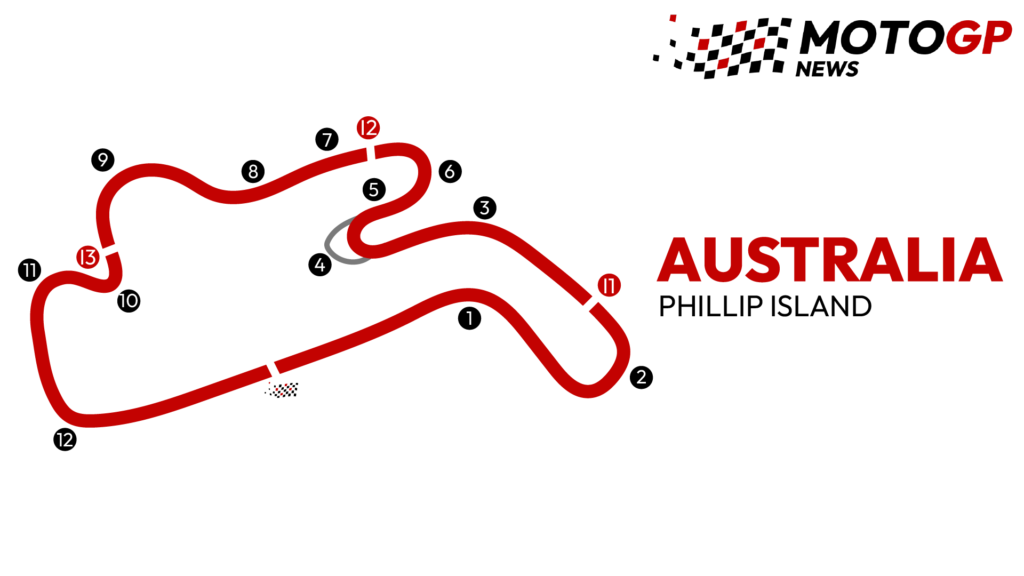
Riders and fans alike love Phillip Island, with the home of the Australian Grand Prix the ideal circuit for MotoGP races. The track has a perfect blend of everything required to produce an exhilarating premier class race as well as the regular unpredictability caused by the weather.
Doohan Corner is a testing first turn taken at in excess of 100mph, with riders also pulling on the brakes after hitting speeds exceeding 220mph down the Gardner Straight. The Southern Loop then instantly offers another chance for an overtake or to resolve a fight exiting Turn 1.
It is key to get the Southern Loop right as riders utilise the edge of their tyres for the crucial charge through Stoner Corner and into another prime overtaking point at the Miller Corner hairpin. Like Turn 1 into T2, fights will often extend out of Miller and into Siberia (or Turn 6).
Overtaking is even possible albeit very difficult through the high-speed Turns 7 and 8 on the run to Lukey Heights (T9), where riders battle each other and a quick drop over the crest for the T10 hairpin. Turns 11 and 12 are then key for positioning a bike to fly down the straight.
Previous 10 winners of the MotoGP Australian Grand Prix
Below, MotoGP News has listed the last 10 premier class winners at the Australian Grand Prix…
| YEAR | RIDER | TEAM | CONSTRUCTOR |
| 2014 | Valentino Rossi | Yamaha | Yamaha |
| 2015 | Marc Marquez | Honda | Honda |
| 2016 | Cal Crutchlow | LCR Honda | Honda |
| 2017 | Marc Marquez | Honda | Honda |
| 2018 | Maverick Vinales | Yamaha | Yamaha |
| 2019 | Marc Marquez | Honda | Honda |
| 2022 | Alex Rins | Suzuki | Suzuki |
| 2023 | Johann Zarco | Pramac | Ducati |
| 2024 | Marc Marquez | Gresini | Ducati |
| 2025 | Raul Fernandez | Trackhouse | Aprilia |
Home hero Casey Stoner won the Australian Grand Prix six times in a row from 2007-12
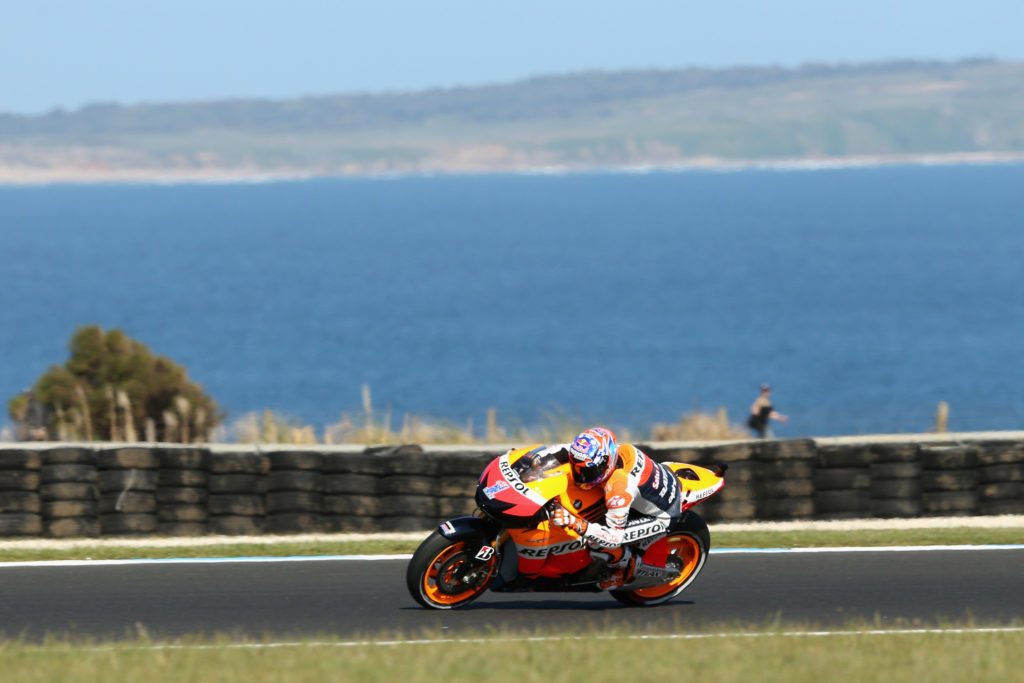
Unlike Gardner and Doohan, who delivered each of their home victories riding Honda bikes, Stoner even started his streak with four home wins on a Ducati before taking two for Honda. His run also made Stoner the most successful rider in the Australian GP’s history, at the time.
Stoner’s victory at Phillip Island in 2012 further denoted the last of his 38 MotoGP race wins in the Australian’s penultimate race. The Southport, Queensland native’s debut home win in 2007 was also Stoner’s first win as a MotoGP champion after taking the title one round prior.
Valentino Rossi had shown that it was possible to dominate the Australian Grand Prix riding bikes from different constructors from 2001 to 2005 with three racing Honda machines and two with Yamaha bikes. The Italian joined Stoner as a six-time Australian GP winner in 2014.
A dominant win by Marco Melandri for the Fortuna Honda squad in 2006 denied Rossi from sealing six consecutive Australian Grand Prix wins. It was retirement that ended Stoner’s run with the Aussie calling time on his MotoGP career aged 27 after losing his love for the sport.
Marc Marquez beat Jorge Lorenzo to win one of MotoGP’s all-time great races at the 2015 Australian Grand Prix

The 2015 Australian Grand Prix is even regarded as one of the greatest races in the MotoGP era since 2002 as Rossi saw Yamaha teammate Jorge Lorenzo start to ruin his championship lead. Rossi led Lorenzo by 18 points arriving at Phillip Island, yet would go on to lose by five.
Phillip Island staged round 16 of the 18 held in 2015 and the race started poorly for Rossi as the Italian would only secure P7 on the grid, while Lorenzo slotted into P3 as Marc Marquez of Honda scored pole. Iannone also put one Ducati in the mix and stole the lead into Turn 1.
Rossi struggled to make much progress during the early laps as Iannone, Marquez, Lorenzo, Cal Crutchlow and Dani Pedrosa made it a six-way fight at the front. Even with the threat of Crutchlow and Pedrosa then fading, the leading four continued to swap positions most laps.
Lorenzo would eventually be the rider to break away from the pack and build a modest gap whilst Marquez, Iannone and Rossi jostled for position. Yet even with the Spaniard boasting a sizable margin onto the last lap, the victory would not go the way of the eventual champion.
As Rossi and Iannone rubbed their way through Honda Corner (which became Miller Corner in 2022 after home favourite Jack Miller), Marquez saw Lorenzo start to escape and slashed four-tenths of a second out of the Spaniard’s six-tenths advantage with a lunge into Siberia.
Marquez very much now had the bit between the Honda hero’s teeth after latching onto the rear of Lorenzo’s Yamaha through Turns 7 and 8 before positioning his bike on the outside at Lukey Heights. A dive at T10 gave Marquez the win as Iannone and Rossi again traded spots.
Receive racing news and updates twice a week to your mailbox


